
FROM DOWN HERE.↘
Ottawa has never finished one of its ten-year Housing and Homelessness Plans.
That sounds more inflammatory than it is. The first lasted about six years. Its replacement lasted about six years. We are now on the third.
There are apparently six years in a municipal decade.
That might be funny if we were talking about flower beds. We’re talking about homelessness.
I know these systems from more than City reports. I have lived on the other side of their policies, and I now work in peer outreach. I have also spent an unreasonable amount of time reading the plans that are supposed to govern them.
What bothers me isn’t that the plans changed. Governments should change course when something isn’t working.
It’s what happens to the promises when they do.
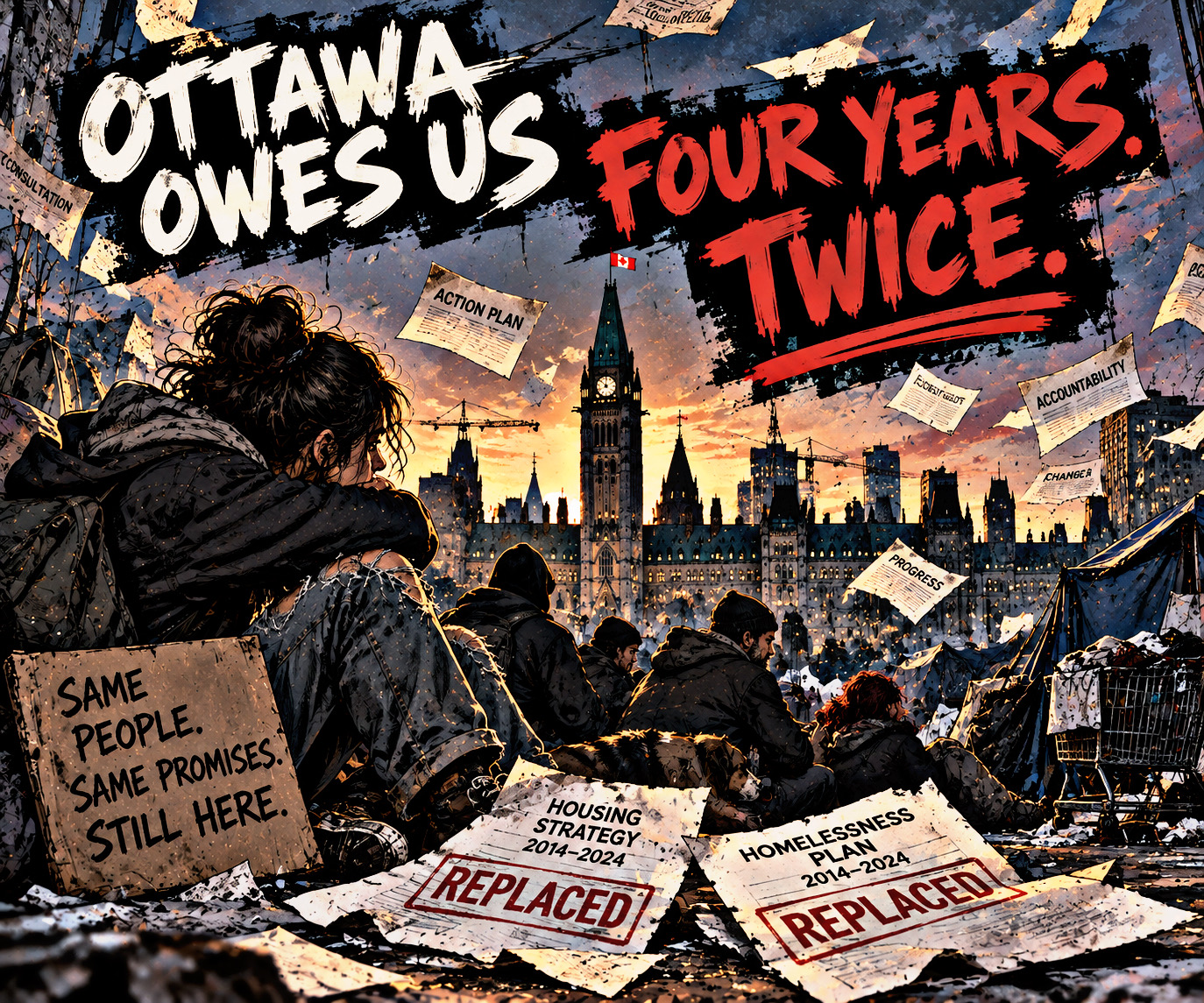
Ottawa’s first ten-year Housing and Homelessness Plan was supposed to run until 2024. Then, in 2020, it was replaced with another plan. Again, in 2026, that one was replaced too.
Each time, the public gets another policy document with big plans for a brighter future.
The problem is: when will the future they keep promising actually arrive?
Ottawa calls these changes “refreshes.” Fair enough. COVID happened. Housing costs exploded. Homelessness grew. The toxic drug supply continues to worsen. Our health-care and mental-health supports are overrun. Services are gatekept and wrapped in red tape. Nobody should expect government to blindly follow a plan that no longer serves people in the way it was intended to.
But a plan “refresh” is not the same thing as a reset button.
The last plan contained measurable promises: eliminate chronic and unsheltered homelessness, reduce overall homelessness by 25 per cent, reduce Indigenous homelessness by 25 per cent, and build hundreds of affordable homes each year. Some programs made real progress. Others did not meet those ambitions.
Not meeting the goals we set out is okay, though. It is actually very telling. It tells us the problem is larger or more complicated than originally anticipated.
Now, several of those hard numerical targets are gone from the new plan. That seriously obstructs our ability to gauge the severity of these issues and measure whether we are actually making progress.
That may make the system more flexible.
It also makes the promises more flexible.
And it gives the City plausible deniability when confronted with potential failures.
A target saying homelessness will fall by 25 per cent can plainly fail. A direction saying an indicator should “increase” or “decrease” is considerably harder to pin to the wall.
The City has actually described the new approach as moving away from longer planning cycles.
Inside a ten-year plan.
I couldn’t improve that line if I tried.
There is another clock underneath all this paperwork. It belongs to the people the plans are about.
Six years is six winters outside. Six years waiting for supportive housing. Six years moving through shelters, couch surfing, encampments and rooming houses while governments refine how they plan to solve the problem you are living.
Six years being told to be patient.
Six years waiting for your name to reach the top of the list.
Those people don’t get a refresh.
I find the contrast particularly striking because poor people know administrative accountability very well. Miss paperwork. Miss a deadline. Fail to report a change. Government wants an explanation. Need an exception? Make sure all your supporting documents are accounted for.
Fine.
Apply the same standard upward.
Ottawa promised ten years and made it roughly six. Twice.
I don’t want another glossy report explaining that circumstances evolved. I want to know what happened to the unfinished promises.
Put the old plans beside their replacements and show us what survived, what worked, what failed and what disappeared.
If something failed, say so. Failed policy isn’t scandalous. Governments try things. Conditions change. Sometimes they get it wrong.
I am less offended by government admitting a policy failed than I am by watching failure dissolve into “evolving priorities.”
There is no shame in trying something that does not work.
There is shame in making it impossible to tell what happened.
Maybe Ottawa’s new plan will work better. I hope it does.
But before asking people to believe in what City Hall intends to accomplish by 2035, close the old accounts.
Ottawa owes us four years. Twice.