
FROM DOWN HERE.↘
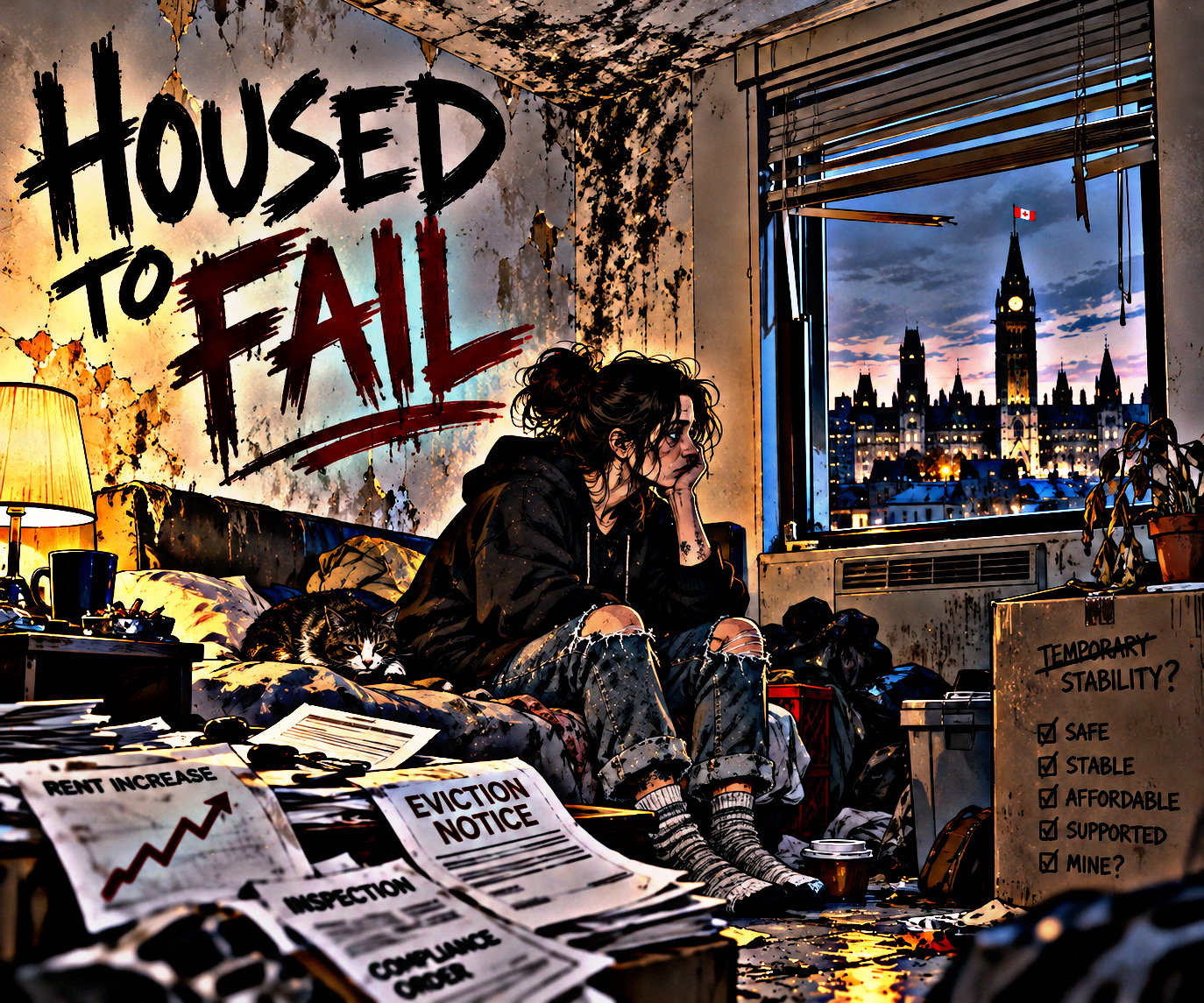
One of the strangest contradictions inside the modern homelessness system is that it publicly presents itself as “Housing First” while often practicing something much closer to “Housing Suddenly.”
The official philosophy behind Housing First sounds compassionate and logical. Housing is supposed to come before treatment, before sobriety, before perfect stability, before recovery. The idea is that people cannot heal while living in constant survival mode. And that part is true. Someone sleeping outside, constantly moving, withdrawing, traumatized, sleep deprived, exposed to violence, and psychologically exhausted is not operating from a stable foundation. Housing absolutely matters.
But somewhere between the theory and the reality, the system mutates into something else entirely.
A person can spend months or years being assessed, scored, documented, prioritized, referred, case-conferenced, and monitored inside Coordinated Access systems, only to suddenly be dropped into a housing placement with almost no meaningful long-term support structure attached to it. After all the bureaucracy, all the invasiveness, all the waiting, the final act often feels bizarrely abrupt. One day the person is surviving outside. The next day they are handed keys and expected to immediately function inside a rigid housing environment that may bear almost no resemblance to the life they were surviving days earlier.
This is where the absurdity becomes impossible to ignore.
The exact factors that made the person “high acuity” enough to finally receive housing are often the same factors the housing environment itself punishes most aggressively.
The person was prioritized because they had severe trauma, addiction, mental health instability, crisis survival patterns, poor sleep, distrust, repeated hospitalizations, difficulty with routines, emotional dysregulation, institutional exhaustion, or difficulty maintaining previous housing. Then they are placed into a building with strict behavioural expectations, surveillance, complaint systems, tenancy obligations, neighbour conflict risks, appointment requirements, visitor restrictions, cleanliness standards, medication expectations, noise rules, and administrative obligations that assume a level of stability the person was specifically identified as lacking.
The system essentially says: “You are vulnerable enough to deserve housing because your life is extremely unstable. Now immediately become stable enough to keep it.”
And often this transition happens with shockingly little real support.
Many people imagine supportive housing means constant meaningful support. Sometimes it does. But often support becomes minimal once someone is physically indoors. A worker who once checked in frequently may now have an impossible caseload. Contact may drop to occasional visits, brief appointments, or crisis response only. Some tenants report barely seeing their worker unless something goes wrong. Others are expected to independently navigate appointments, groceries, medication, landlord conflict, neighbour issues, budgeting, relapse triggers, mental health episodes, isolation, trauma responses, and bureaucratic demands almost immediately after placement.
The public often imagines housing itself solves homelessness. But homelessness is not just the absence of walls. Long-term homelessness changes people neurologically, psychologically, socially, physically, and emotionally. Survival mode becomes normal. Hypervigilance becomes normal. Distrust becomes normal. Chaos becomes normal. Isolation becomes normal. Many people have spent years adapting to environments where every hour revolves around safety, withdrawal prevention, food, survival, conflict avoidance, and mobility. Then suddenly they are expected to quietly exist alone inside an apartment with almost no transition period and little acknowledgment of the psychological violence that abrupt adjustment can create.
Some people deteriorate rapidly indoors. The silence becomes overwhelming. Isolation intensifies mental illness. Drug use becomes more dangerous behind closed doors. Trauma memories return once survival urgency slows down. Depression deepens. Paranoia worsens. Some people become terrified of losing the housing and psychologically collapse under the pressure of maintaining it perfectly. Others become overwhelmed by basic administrative responsibilities because years of homelessness destroyed their executive functioning and routines.
And when things begin falling apart, the system often responds punitively instead of relationally.
Noise complaints become behavioural concerns. Missed meetings become disengagement. Relapse becomes tenancy risk. Visitors become safety issues. Emotional crises become incidents. Conflict becomes documentation. The same system that once treated someone’s instability as evidence of vulnerability now treats that instability as evidence they are failing housing.
This is the cruel inversion at the center of the process.
The person was fast-tracked into housing because the system identified them as deeply unstable, traumatized, addicted, mentally unwell, or unable to survive safely outside. Yet once housed, the housing environment itself often demands exactly the kind of stability the person never possessed in the first place.
Housing providers and systems frequently frame this as “supportive accountability” or “housing expectations,” but from the perspective of many formerly homeless tenants, it feels more like conditional tolerance. You are accepted as long as your trauma remains manageable, your addiction remains invisible, your crises remain quiet, your mental illness remains non-disruptive, and your suffering does not interfere too much with institutional order.
Then comes the permanent stain of failure.
Once a placement collapses, the file remembers.
The notes begin accumulating: “unsuccessful placement” “poor housing retention” “behavioural issues” “non-compliance” “service restrictions” “property damage” “staff conflict” “guest concerns” “eviction history”
Very little context survives alongside these phrases. The file rarely fully captures that the placement may have been unsafe, isolating, under-supported, retraumatizing, exploitative, or psychologically incompatible with the person’s needs. Instead the failure quietly becomes attached to the person’s identity inside the system.
This is where the process becomes even more dangerous.
Trying to restart after housing loss is often significantly harder than entering the system the first time. The person now re-enters with a damaged institutional reputation. Workers reading the file may approach them differently before even meeting them. Providers may quietly avoid accepting them. Support systems may become more cautious, more conditional, more risk-averse. The individual may carry shame, distrust, exhaustion, and hopelessness from the failed placement itself. Some become terrified of trying again because they understand the next failure may permanently narrow future opportunities.
Service bans make this even worse. A person who becomes banned from shelters, drop-ins, housing providers, or support programs can rapidly lose access not just to services, but to visibility itself. Since so much of the Coordinated Access system depends on ongoing contact, engagement, and file updates, exclusion from services can effectively make someone administratively disappear. A person may still be homeless, still be suffering, still be in crisis, but now the system sees less of them. And the less visible someone becomes institutionally, the harder it often becomes to re-enter the very process supposedly designed to help them.
This creates a devastating cycle where the people with the highest needs gradually become the people the system fears engaging with most. The exact traits created by chronic homelessness, trauma, addiction, instability, and institutional neglect become the same traits later used to justify distance, caution, restriction, surveillance, or exclusion.
The public narrative says Housing First works because housing creates stability. But the reality is that housing alone is not enough when the system surrounding the housing remains fragmented, underfunded, bureaucratic, risk-obsessed, and disconnected from the actual psychological reality of surviving homelessness.
A key in someone’s hand is not the same thing as recovery. It is not the same thing as community. It is not the same thing as healing. It is not the same thing as support. And when systems pretend otherwise, they end up placing deeply wounded people into inadequate environments and then quietly blaming them when survival patterns continue inside the only life they have known for years.