They Call It Reintegration. Then They Build Tiny Institutions.
FROM DOWN HERE.↘
One of the biggest contradictions inside the homelessness system is that it constantly talks about “reintegration,” “independent living,” “community inclusion,” and “housing stability” while simultaneously building environments that often feel nothing like normal life.
The public imagines supportive housing as a compassionate stepping stone back into society. The phrase itself sounds hopeful. People picture small apartments, support workers checking in, stability slowly returning, somebody rebuilding their life with dignity and autonomy.
But many supportive and transitional housing environments do not actually resemble ordinary independent living at all.
They resemble managed containment.
And the deeper you look at the structure of many of these places, the stranger the contradiction becomes.
A person spends years surviving outside and is told they need to learn how to “reintegrate into society.” Then they are placed into a building where almost every tenant comes from the exact same street environment, the exact same trauma ecosystem, the exact same addiction culture, the exact same survival networks, and often the exact same social conflicts that existed outside already.
This is not automatically a bad thing. Familiarity matters. Community matters. Friendship matters. People surviving homelessness often develop stronger bonds with each other than with any institution trying to “help” them. Being housed alongside familiar people can reduce isolation and terror. It can preserve relationships that kept people alive outside.
But pretending there are no serious contradictions here is dishonest.
If somebody struggles with chaotic survival behaviours, addiction patterns, conflict regulation, criminalization, exploitation, trauma responses, or emotional instability, what exactly happens when you concentrate dozens or hundreds of equally traumatized people together inside one tightly controlled building with minimal privacy, minimal space, constant surveillance, and little real autonomy?
The answer is predictable: the behaviours compound. Conflict compounds. Drug use compounds. Psychological instability compounds. Tension compounds. Survival dynamics follow people indoors.
Then systems act surprised when instability continues.
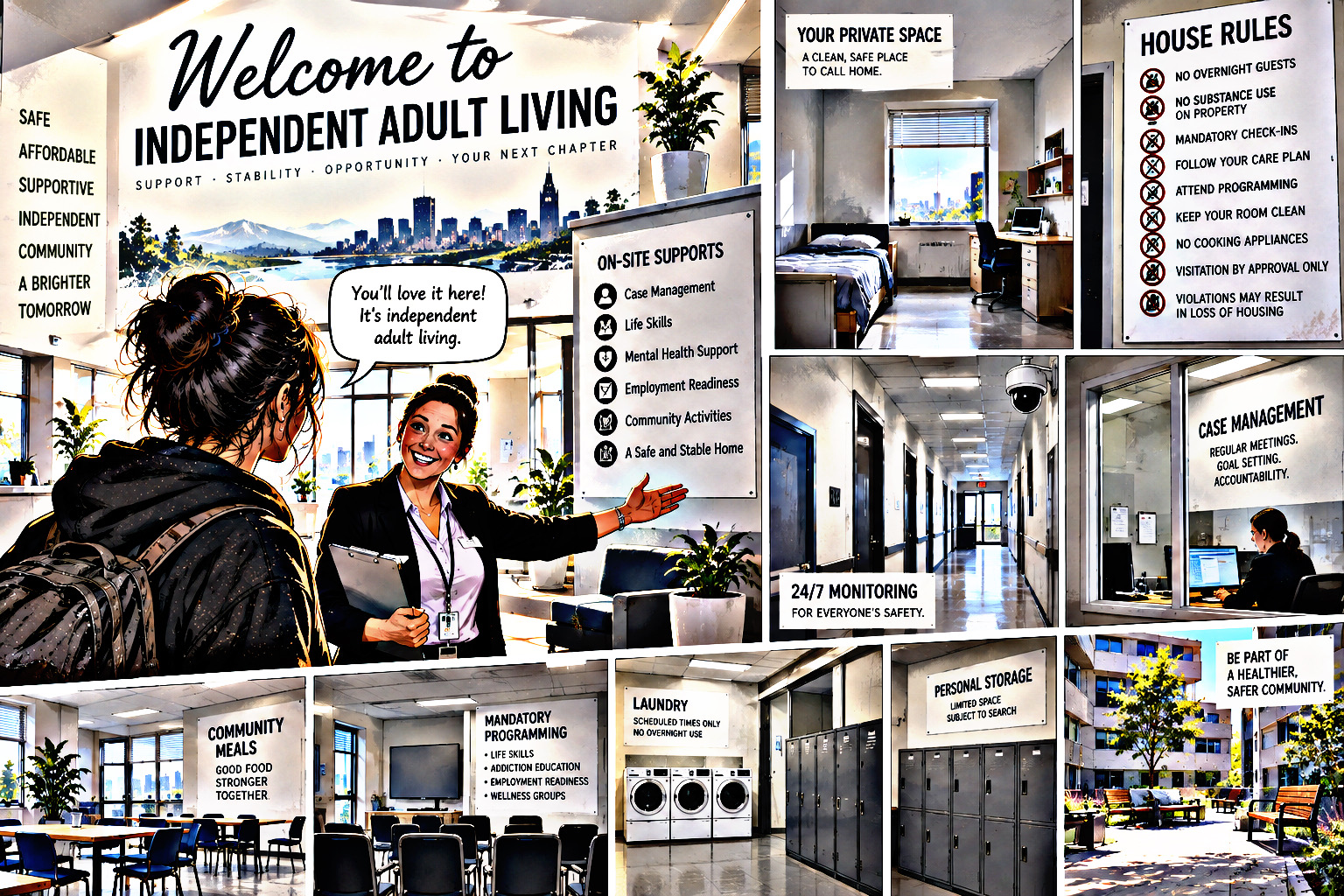
What makes this even more absurd is that many of these buildings simultaneously recreate institutional environments while claiming to prepare people for independent adulthood.
Some units are barely larger than jail cells. Tiny rooms. Tiny beds. Tiny windows. Sometimes shared bathrooms. Sometimes no kitchen. Sometimes no meaningful private living space at all. A person who spent years being controlled by shelters, hospitals, prisons, treatment systems, or the street itself finally receives “housing” only to end up inside another highly regulated environment where almost every aspect of life remains supervised.
Meal times are structured.
Visitors are restricted.
Overnight guests may be banned entirely.
Tenants may face curfews.
Staff monitor “behaviour.”
Wellness checks become normalized.
People can be written up for conflict.
Some places even limit how many nights someone can sleep elsewhere before risking consequences or losing their unit.
Think about how bizarre this actually is.
No ordinary middle-class adult lives this way. No condo owner appearing before city council complaining about encampments would tolerate being told:
● when they are allowed to eat ● whether their partner can stay overnight ● how many nights they are allowed away from home ● whether guests are approved ● whether staff can inspect their space ● whether their emotional instability is becoming a “concern” ● whether their neighbours are reporting them ● whether missing appointments jeopardizes housing stability
Yet homeless people are expected to accept these conditions as “support.”
The system says it is teaching independence while simultaneously restricting autonomy at nearly every level.
And then people wonder why many tenants psychologically deteriorate.
Because human beings do not become healthier through constant institutionalization.
A person cannot fully rebuild adult identity while remaining trapped inside environments where they are still fundamentally treated as a managed risk population.
Many supportive housing environments unintentionally communicate the same message over and over: you are not fully trusted to exist freely.
That feeling matters psychologically.
Especially for people who have already spent years under surveillance through shelters, welfare systems, probation, hospitals, child welfare systems, prisons, psychiatric wards, or institutional housing programs.
The tragedy is that these rules are often justified through the language of safety and stability. And sometimes there are legitimate reasons for certain restrictions. Buildings may genuinely be trying to prevent overdoses, violence, exploitation, trafficking, predatory guests, fires, or deaths. Staff are often operating inside underfunded systems with impossible liability concerns. But acknowledging the reasons does not erase the contradiction.
You cannot claim to be preparing people for ordinary independent life while housing them in environments that function fundamentally differently from ordinary life.
You cannot call something “community reintegration” while creating heavily concentrated vertical poverty institutions where trauma, addiction, surveillance, and instability are compressed together under one roof.
You cannot tell people they need to rebuild healthy adult functioning while denying them many of the basic freedoms adulthood normally includes.
And perhaps the cruelest part is this: when people fail inside these environments, the failure is often individualized instead of structurally examined.
If somebody breaks rules, relapses, spirals mentally, isolates, explodes emotionally, or loses housing, the file often frames this as evidence the person “wasn’t ready,” “couldn’t maintain housing,” or “struggled with compliance.”
Far less attention gets paid to whether the environment itself was psychologically survivable.
Because many of these buildings exist in an impossible contradiction: they are expected to function simultaneously as housing, addiction management, mental health stabilization, trauma containment, behavioural regulation, liability reduction, public order management, overdose prevention, and social reintegration systems all at once.
And no building can successfully carry all those contradictions forever.
Especially not while trying to convince tenants they are finally “free” after years of surviving systems that controlled nearly every part of their lives already.